Buying Guides
How to Evaluate a Wholesale HDD and SSD Supplier: 7 Key Factors
Discover seven factors for evaluating HDD and SSD suppliers, including product verification, specifications, pricing, availability, warranty and delivery.
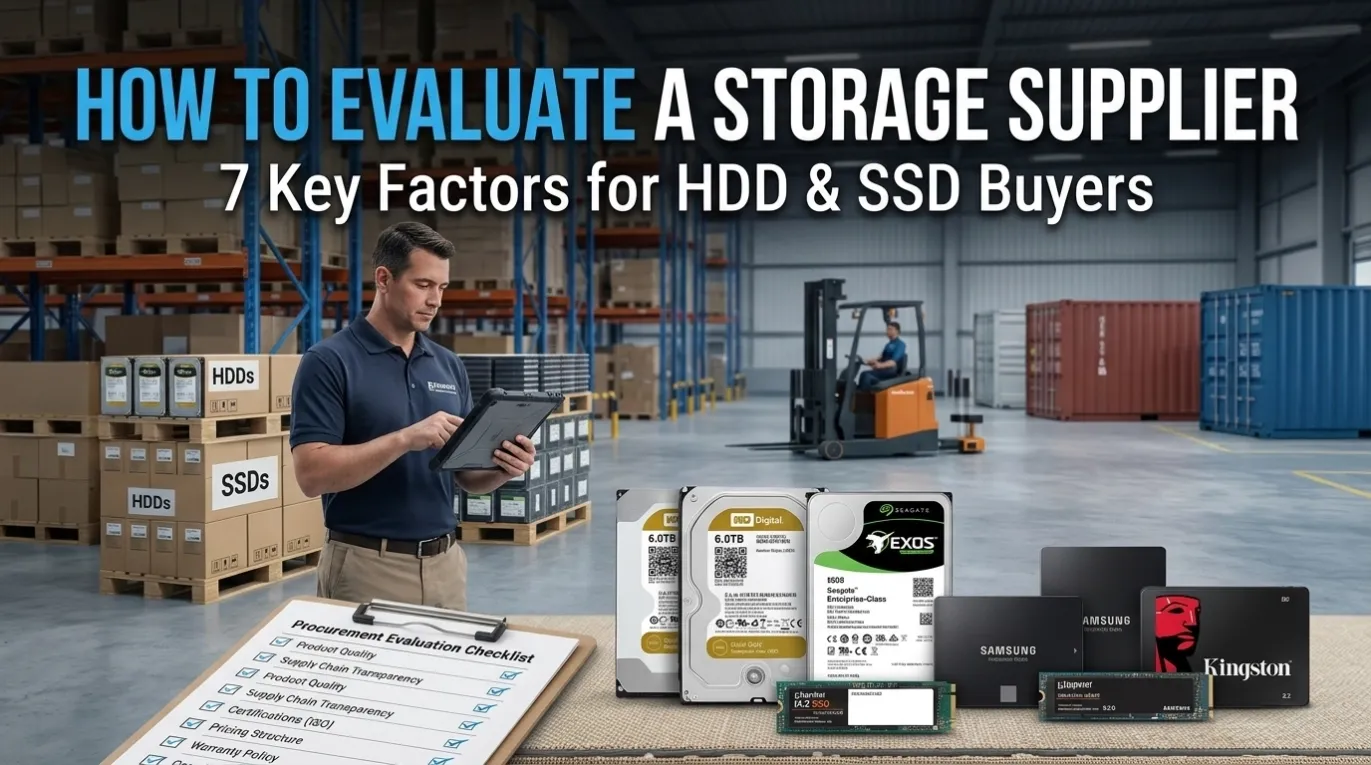
How to Evaluate a Wholesale HDD and SSD Supplier: 7 Key Factors
Choosing a wholesale HDD and SSD supplier is an important decision for distributors, system integrators, computer retailers and e-commerce sellers.
Storage products may look similar based on capacity or product category, but differences in model specifications, product condition, warranty terms and supply arrangements can have a significant impact on purchasing decisions.
A reliable sourcing process should evaluate more than the quoted price.
This guide explains seven important factors to consider when evaluating a wholesale HDD and SSD supplier.
1. Product Range and Brand Coverage
Start by checking whether the supplier can support the product categories and brands required by your business.
Common storage categories include:
- Enterprise HDDs
- NAS and surveillance HDDs
- SATA SSDs
- M.2 NVMe SSDs
- Portable SSDs
- Memory cards
- USB flash drives
Depending on your target market, you may also require products from manufacturers such as Seagate, Samsung, Western Digital, Toshiba, Kingston, Crucial and SanDisk.
A broad product range can make sourcing more convenient, but product suitability and availability still need to be verified.
2. Exact Model and Specification Verification
Product model verification is one of the most important steps in storage procurement.
Before confirming an order, check:
- Manufacturer
- Full model number
- Capacity
- Interface
- Form factor
- Product series
- Technical specifications
For HDDs, SATA and SAS interfaces must be distinguished.
For SSDs, buyers should verify whether the product uses SATA or PCIe NVMe.
For memory cards and USB drives, capacity, connector and speed classifications should also be checked.
Do not accept a product substitution based only on similar capacity or appearance.
3. Product Condition and Documentation
Buyers should clearly understand the condition of the products being offered.
Confirm whether the products are:
- New retail products
- New bulk-packaged products
- Other explicitly described conditions
Do not assume product condition based on photographs or product descriptions alone.
Where relevant, request supporting product information, model details, serial-number information and applicable documentation.
Any special requirements should be agreed before the order is confirmed.
4. Availability and Quantity Confirmation
A quotation does not automatically guarantee that the full order quantity is available.
For bulk procurement, confirm:
- Required quantity
- Quantity available for the exact model
- Whether the order can be fulfilled in one batch
- Whether partial delivery is possible
- Expected preparation time
- Whether repeat orders can be supported
For project buyers, delivery timing and model consistency may be as important as the unit price.
5. Pricing and Commercial Terms
Compare supplier quotations carefully.
The quoted price should be evaluated together with:
- Exact model and specification
- Product condition
- Quantity
- Currency
- Payment terms
- Packaging
- Shipping arrangements
- Warranty conditions
A lower price may not represent better value if the model, condition or commercial terms are different.
For larger orders, confirm the validity period of the quotation and whether prices may change before order confirmation.
6. Warranty and After-Sales Support
Warranty conditions should be clear before purchasing.
Ask the supplier to confirm:
- Applicable warranty period
- Warranty provider
- Required documentation
- Return and replacement procedures
- Responsibility for shipping costs
- How defective products are handled
Warranty arrangements can differ by manufacturer, model, sales channel and destination market.
Do not assume that every product has identical warranty coverage.
7. Delivery and Communication
A supplier should be able to communicate clearly about order preparation and delivery arrangements.
Before placing an order, confirm:
- Shipping destination
- Available shipping methods
- Estimated delivery schedule
- Export and import documentation requirements
- Packaging arrangements
- Shipment tracking information, where available
For international B2B purchasing, clear communication helps reduce misunderstandings during order execution.
8. A Practical Supplier Evaluation Checklist
Use the following checklist when comparing potential HDD and SSD suppliers.
Evaluation Factor | Questions to Ask |
|---|---|
Product Range | Can the supplier support your required product categories and brands? |
Model Verification | Are exact model numbers and specifications provided? |
Product Condition | Is the product condition clearly stated? |
Availability | Is the required quantity confirmed? |
Pricing | Are quotation validity and commercial terms clear? |
Warranty | Are warranty conditions and procedures explained? |
Delivery | Are shipping arrangements and schedules confirmed? |
For important projects, document the supplier's answers and compare offers on an equivalent specification basis.
Conclusion
Evaluating a wholesale HDD and SSD supplier requires more than comparing unit prices.
Product range, exact model verification, product condition, availability, commercial terms, warranty and delivery all influence procurement risk.
A structured evaluation process helps distributors, retailers, system integrators and project buyers make more informed sourcing decisions.
Looking for HDD and SSD Wholesale Supply?
OV CHIP STORAGE supports business enquiries for branded HDDs, SSDs and other storage products, including enterprise storage and flash storage categories.
Share your required brands, model numbers, capacities, quantities and destination country with our team.