Buying Guides
How to Start Your Own USB Flash Drive Brand: An OEM Guide
Learn how to develop a private-label USB flash drive product by choosing specifications, connectors, capacity, logo customization and packaging.
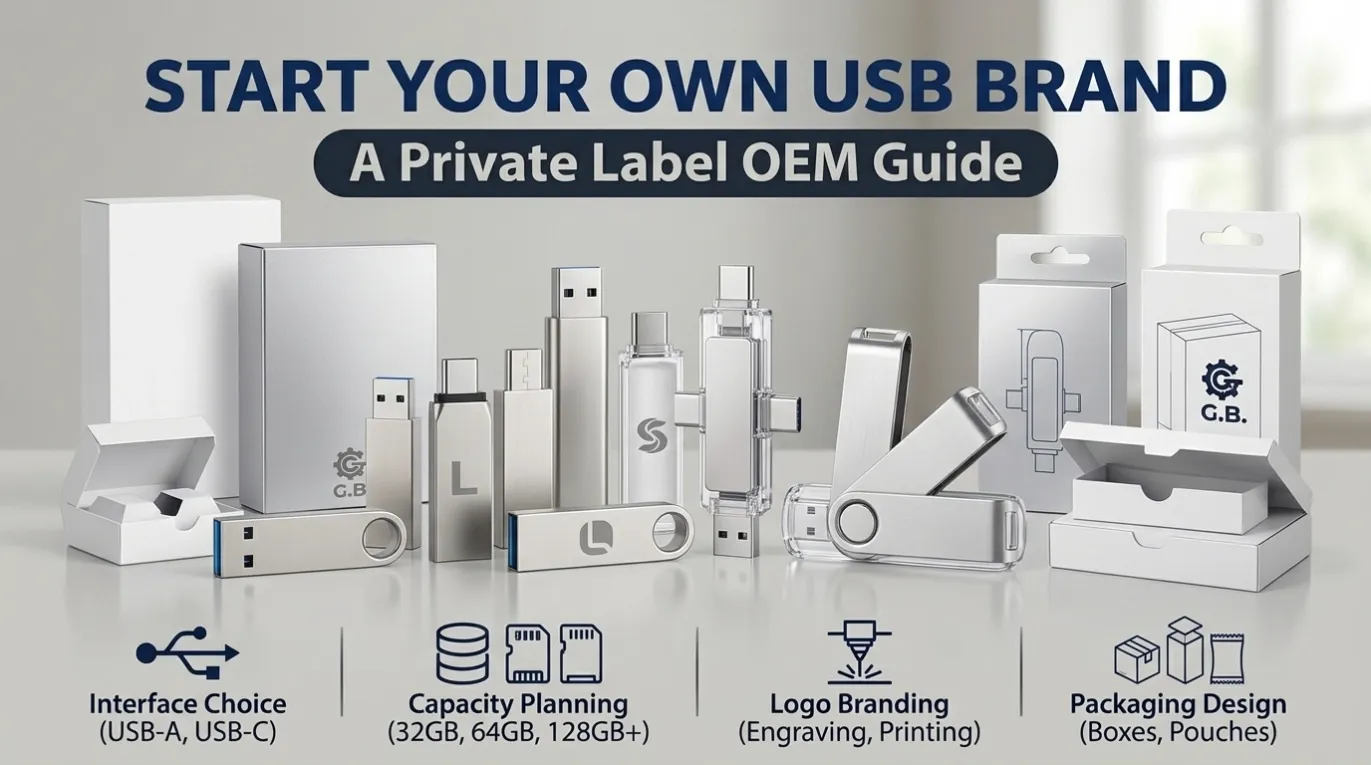
How to Start Your Own USB Flash Drive Brand: An OEM Guide
Launching a private-label USB flash drive brand can help distributors, e-commerce sellers and business buyers develop their own storage product lines.
Instead of selling only existing branded products, businesses can explore customized USB flash drives with their own logos, product configurations and packaging.
However, starting an OEM project requires more than selecting a product appearance.
Product specifications, connector types, storage capacity, branding requirements, packaging and order quantities should all be considered before moving forward.
This guide explains the main steps involved in developing a private-label USB flash drive product.
1. Define Your Target Market
Before selecting a USB flash drive, identify the customers you want to serve.
Possible target markets include:
- Online marketplace customers
- Computer accessory retailers
- Office supply distributors
- Corporate promotional product buyers
- Educational institutions
- Wholesale distributors
Different customer groups may have different requirements for capacity, connector type, design and price positioning.
Understanding your target market helps establish the product direction.
2. Choose the Right USB Flash Drive Type
USB flash drives are available in different connector and interface configurations.
USB-A Flash Drives
USB-A remains widely used in desktop computers, laptops and other compatible equipment.
USB-C Flash Drives
USB-C drives are designed for compatible modern devices with supported USB-C storage functionality.
Dual-Connector and 4-in-1 USB Drives
Multi-connector products may support several device types.
Depending on the product design, a 4-in-1 USB flash drive can combine multiple connectors in one device.
Before selecting a configuration, identify the connector types required by your target customers.
3. Select Capacity and USB Interface
Capacity and interface are important product positioning decisions.
Common capacity options may include:
- 8GB
- 16GB
- 32GB
- 64GB
- 128GB
- 256GB
Actual available capacities depend on the product configuration.
USB interface options may include USB 2.0 and USB 3.0.
USB 2.0 products may suit general-purpose storage requirements, while USB 3.0 products may be considered for users who require higher transfer performance.
Actual read and write speeds depend on the complete product specifications and host device.
4. Customize Your Brand Logo
Logo customization is one of the main elements of private-label development.
Depending on the selected product design, branding options may include:
- Logo printing
- Logo placement selection
- Customized product appearance
- Brand color coordination
Before confirming the design, provide the supplier with the logo file and preferred placement requirements.
A digital design preview should be reviewed before final production arrangements.
5. Choose Retail Packaging
Packaging is another important part of private-label storage products.
Possible packaging requirements include:
- Standard retail packaging
- Customized printed packaging
- Brand logo and product information
- Barcode and product labels
- Capacity and interface identification
For marketplace sellers, packaging should also be suitable for the target sales channel and market requirements.
Any required product documentation or compliance information should be confirmed before the order is finalized.
6. Confirm Product Specifications and Quality Requirements
Before proceeding with an OEM order, confirm the product specifications in writing.
Important details include:
- USB interface
- Connector configuration
- Storage capacity
- Read and write performance requirements
- Product dimensions
- Logo customization
- Packaging design
- Order quantity
- Quality inspection requirements
For storage products, buyers should also establish how product capacity and functionality will be checked.
Do not rely on appearance alone when evaluating a USB flash drive.
7. Understand MOQ, Samples and Order Planning
OEM projects may have different minimum order quantities depending on the product design, customization method and packaging requirements.
Before confirming a project, ask about:
- Minimum order quantity (MOQ)
- Sample availability
- Customization costs
- Packaging costs
- Production or preparation lead time
- Payment terms
- Shipping arrangements
A sample or approved design reference can help both parties confirm the expected product configuration before a larger order.
Actual terms should be confirmed with the supplier for each project.
8. What Should You Prepare Before Requesting an OEM Quotation?
To help suppliers evaluate your project, prepare the following information:
Check Item | Information to Provide |
|---|---|
Target Market | Country and sales channel |
Product Type | USB-A / USB-C / 4-in-1 |
Interface | USB 2.0 / USB 3.0 |
Capacity | Required storage capacity |
Logo | Logo file and placement |
Packaging | Standard or customized |
Quantity | Estimated order quantity |
Performance | Required read and write specifications |
Documentation | Required product documents |
Destination | Shipping country |
The more clearly the project requirements are defined, the easier it is to evaluate suitable product options.
Conclusion
Developing your own USB flash drive brand involves several decisions, including target-market positioning, connector configuration, capacity, interface, logo customization and packaging.
For e-commerce sellers, distributors and private-label businesses, a clearly defined product specification is the foundation of a successful OEM project.
Planning Your Own USB Flash Drive Brand?
OV CHIP STORAGE supports business enquiries for OEM/ODM storage products, including USB flash drives and other storage categories.
Share your preferred USB configuration, capacity, logo requirements, packaging design, estimated quantity and destination country with our team.